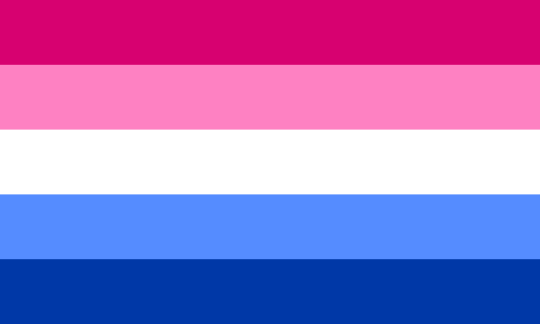
neopronouns:

rosboy: a feminine boy; someone who both considers themselves a boy and has some significant connection to femininity, either in their gender or expression; a feminine-aligned boy; an umbrella term for all identities that involve being both a boy and feminine

azurgirl: a masculine girl; someone who both considers themselves a girl and has some significant connection to masculinity, either in their gender or expression; a masculine-aligned girl; an umbrella term for all identities that involve being both a girl and masculine

these flags are based on the feminenby and masculenby flags and the man and woman flags! prefixes come from the words “rose” and “azure”, which are specific shades of pink and blue respectively. both of these prefixes are similar to how many european languages say ‘blue’ and ‘pink’, and the english words both relate to nature, which i felt unified the terms!

-Ap

Demigal Pride Flag

Demigal: experiencing gal as a partial gender identity. Similar to demiwoman, demigyne and demigirl.

[ID: 7 stripes of two greys, orange, red, purple and two grays. End ID.] –A-P

Coining Some New Objectum Terms!

absolutely0bjectum:

*For pronunciation, these all use the soft g! 

Mangerum, attraction to food. (mon-ger-um)

The name comes from the french word for “eating” which is manger! 

image

Vestiagum, attraction to clothes. (vest-ee-ag-um)

image

Automobilum, attraction to cars. (auto-mobil-um)

The colours come from popular car colours! It’s inspired by @kinnie-babys-flags​ carkin flag! 

image

Postiagum, attraction to signs. (post-ee-ag-um)

The colours come from common sign colours! 

image

Tagging to spread (if you don’t do this type of thing please ignore me!) @neopronouns@beyond-mogai-pride-flags@objectum-gendersylph@urfaveisobjectum@aceandarothingies

-Ap

Alloaroplatonic Pride Flag

Interchangeable with aroalloplatonic, aroaloplatonic/aloaroplatonic, alloaroamical/aroalloamical, aroaloamical/aloaroamical, alloarosocial/aroallosocial and aloarosocial/aroalosocial: platonic/amical/social attraction to aroallos/alloaros.

[ID: 5 stripes faded with a shaped diamond square in the middle, colored with two greens, white, yellow and two golden. End ID.] -Ap

Aroaceplatonic Pride Flag

Interchangeable with aroaceamical, acearoamical/acearoplatonic and aroacesocial/acearosocial: feeling platonic/social/amical attraction to aroaces.

Using @aroaesflags​‘s aroace flag shaped as diamond square with its flag lighter/faded around, based on this panplatonic. -A-p

Lovesexual Pride Flag

Lovesexuality: a sexuality that changes depending on who someone is attracted to. This would usually be used if someone is only attracted to their partner or their partner’s gender.

Source -Ap

Postgenderist Flags

Postgenderist Flags

Postgenderism is a social, political and cultural movement which arose from the eroding of the cultural, psychological, and social role of gender, and an argument for why the erosion of binary gender will be liberatory.

Flags by Xaidee via r/QueerVexillology. -Ap

Unibinary

mogai-monarchs:

Unibinary: A gender that turns the binary into one gender; A midbinary/exobinary gender that is a combination of the binary without being fully binary; An abinary/exterbinary/offbinary gender that is the combination of both binary genders in a nonbinary way

~Mod Em

-Ap

MtN Vincian Pride Flag

M2N/MtN (male to neutrois): a transneutral DMAB folket; transitioning from male to neither male nor female.

Vincian: a gay man/a mlm (man-loving-man). 

[ID: 7 stripes of dark teal, purple, cyan, three greens and cyan. End ID.] -Ap

MtF Vincian Pride Flag

image

MtF/M2F Vincian is a DMAB female or otherwise transfeminine gay man; transitioning from male to female while still considering yourself a gay man or a form of mlm.

While for some people MtF/M2F is a problematic terminology, it’s still useful for other folx to express something similar to transfem.

[ID: 7 stripes of dark teal, pale purple, cyan, pink, lighter pink, white pink and cyan. End ID] – Ap

Cisgender Nonbinary Pride Flag

conformant-archive:

A cis* folket can be nonbinary in the sense that they identify with their AGAB in some way, for example someone who is AMAB man or AFAB woman but ey is not binary (midbinary), or usually someone who didn’t passed through any form of transition (social or medical) but eir identity is diverse/divergent and variant.

-Ap

Saphboy

xenoleaf:

Saphboy: a boy that experiences their gender and attraction as sapphic

Boy in this context refers to anyone with a connection to the word boy, regardless of if they mean binary boyhood or if they connect with boyhood in other forms, such as nymboys. The only specificity is that it is a queer and sapphic experience of both gender and attraction.

note: if you are against mspec lesbians do not interact & do not use the flags. do not create discourse on this post.

This probably has been coined before so I don’t want to take credit for the word, but this is my own interpretation of it. The flags were made by me (xenoleaf) on October 9th, 2020 and are free to use when attributed to the term, credits are preferred but not required.

image
image

[image 1 description: in the center of the flag is a dark purple circle. from near the center of the circle 10 diagonal stripes extend outward. from the center stripes outward, 2 are light pink, 4 are green, and 4 are light blue. where the circle overlaps with these stripes they become varying shades of purple. the negative space behind the circle and the stripes forms a blue hourglass shape.]

[image 2 description: in the center of the flag is a dark purple circle. behind it are 8 horizontal parallel stripes. from top to bottom the stripes are blue, light blue, green, pink, green, light blue, and blue.]

-Ap

Folkette Flag

Folkette is the feminine of folket/folk.

[ID: 5 stripes of hot pink, pink, white, pink and hot pink. End ID.]

-AP

Sapphic Guy Pride Flag

Definition: a boy that is wlw; a guy that is a gay woman; a lesbian dude in a cusper or multigender experience.

[ID: 5 stripes of dark orange, pink, violet, light blue and dark blue. End ID.] -Ap

Vincian Girl Pride Flag

image

Definition: a girl that is mlm; a gal that is gay man; an achillean dudette in a cusper or multigender experience.

[ID: 5 stripes of dark teal, soft cyan, soft purple, pink and dark pink. End ID.]

– Ap

Pleonotic Gal Pride Flag

image

Pleonogal (pleonotic gal): a gal that is at least not girl, not woman and/or not female.

[ID: 9 stripes of black, purple, green, yellow, redish orange, wine, golden orange, darkish red and dark burgundy. End ID.] -Ap

Wifamoric Pride Flag

Wifamoric: amplusic femaric folket; an ample and non-straight attraction to women and/or fem-aligned people, with either changing intensity and/or identifiers to ascribe this attraction or simply having a flexible orientation (no matter in which direction this flexibility is inclined).

Not necessarily pluralian, they could fluctuate in a-spectrum or be enboric.

[ID: 6 stripes of black, white, pink, pale yellow, pale green and purple. End ID] -AP

Malaxophobia

mad-pride:

[Image description: A flag that has six horizontal stripes, fading from pink to black. An inverted black heart lies in the middle of the flag. End ID]

Malaxophobia: The irrational fear of love play. Someone suffering from this condition can expect to experience a very high amount of anxiety from merely thinking of love play, let alone actually experiencing it. In fact, their anxiety may be so intense that they may even endure a full blown panic attack as a result of it. Although such an influx of anxiety will not always be the case for everyone suffering from malaxophobia, it is still very plausible to occur nonetheless.

-Ap

Malaxophobia

mad-pride:

[Image description: A flag that has six horizontal stripes, fading from pink to black. An inverted black heart lies in the middle of the flag. End ID]

Malaxophobia: The irrational fear of love play. Someone suffering from this condition can expect to experience a very high amount of anxiety from merely thinking of love play, let alone actually experiencing it. In fact, their anxiety may be so intense that they may even endure a full blown panic attack as a result of it. Although such an influx of anxiety will not always be the case for everyone suffering from malaxophobia, it is still very plausible to occur nonetheless.

-Ap

mogaimom:

Advenagender

A term for an intersex person who would identify as/with their the gender they were assigned at birth (but not necessarily as cis or binary), but struggle to do so because of how perisexism has made them feel alienated from that gender and from perisex people who identify similarly. Advenagender can be thought of as a reclamation of one’s gender — as a way of saying, “I’m going to identify this way on my own terms, regardless of what perisexists have to say.” The -gender suffix can be replaced by whatever one sees fit (e.g. advena- woman, girl, era, feminine, etc. / man, boy, vir, masculine, etc.)

This term isn’t intended to replace “AFAB transfem / AMAB transmasc”; I coined it because I personally don’t identify at all with AFAB/perisex transmasculinity despite being advenavir, but other intersex people are fully entitled to the terms they feel suit them best.

This term can be used by anyone who considers themself intersex, regardless of the nature of their intersexuality or whether they’ve been professionally diagnosed.

Some flags:

CAFAB Advenagender

CAMAB Advenagender

CAXAB Advenagender

-Ap

MtNtF Pride Flag

MtNtF/MtNBtF/MtXtF (male to neutrois to female): transitioning from male to neither male nor female then to female. A double/progressive transition/transfemininity.

-Ap

FtN FtM Pride Flag

FtM: a transmasculine folket, transitioning from female to male or from feminine to masculine; FtN: transitioning from female to neutrois or non-binary; a transneutral AFAB/CAFAB/DFAB/FAAB.

-Ap

MtN MtF Pride Flag

MtF: transitioning from male to female or masculine to feminine, a transfeminine folk; MtN: transitioning from male to neutrois or non-binary, a transneutral AMAB/DMAB/CAMAB/MAAB.

-Ap

Teramoric Pride Flag

Teramoric, tercamoric or ceteramoric: being exclusively enboric/cetero-; a suptilic folket attracted to non-binary folks only.

Based on toramoric and trixamoric (but not on vixenamoric and todamoric which are exclusionary). [ID: 3 strips of yellow, violet and dark green. End ID] – Ap

Bi/Vincian Pride Flag

I decided to make my own flag for being either vincian (gaybo) or bi guy, could be both bi & gay man/boy or questioning mlm/GB+ too.

[ID: 6 stripes of hot pink, lavender, royal blue, cyan, pale purple and dark teal. End ID.]

Female MtN Pride Flag

Female MtN/M2N: a transneufem folket; a transfeminine neutrois person; a transneutral woman considering emself transitioning from male to neutrois/nonbinary.

-Ap

Female FtN Pride Flag

Female F2N/FtN: a transneutral woman considering emself transitioning from female to neutrois/nonbinary; cisfeminine neutrois folket.

-Ap

Male FtN Pride Flag

image

Male FtN/F2N: a transneumasc (transneu + transmasc) folket; a transneutral man considering emself transitioning from female to neutrois/nonbinary; a transmasculine neutrois person.

-Ap

Male MtN Pride Flag

image

Male MtN/M2N: a transneutral man who consider emself transitioning from male to neutrois/nonbinary; a cismasculine neutrois folket.

-Ap

Demibinary Flag

imoga-pride:

Demibinarity: identifying partially as binary, partly other gender(s); having partial binary gender(s).

Similar to half-binary and deminonbinary.

-Ap

Sexually Modified Pride Flag

When you feel you’re sexually modified for any reason. Could be a form of gender, body, sex trait and/or sexuality. Simply it. Nothing else. It does not equate mutilation because sexual modification is intended to be planned/consented. – Ap

Pleonotic Pride Flag

image

Pleonotic: people with identities separated from their synonyms and pleonasms, often leading to not identifying with the gender-affirmative perspective of associating them all as the same.

Examples: being a boy but not a man; being a gal but not a girl; being a male but not a dude.

Coined by @imoga-pride​ -Ap

Female FtM Pride Flag

A female FtM/F2M is a folket who transitions from female to male and still consider emself to be female yet, while not essentially being bigender, cisgender and/or male, since these words often conote sex traits rather than gender identity, but whatever it could be either one or both things.

[ID: 7 stripes of pink, 3 shades of cyan and then 3 of pink. End ID] -Ap

Male FtM Pride Flag

A male FtM/F2M is a folket transitioning from female to male and simultaneously considering emself to be male too. A regular transmasculine person.

To go with my other flags, I’m not ftm/f2m so feel free to redesign. –Ap

[ID: 7 stripes of pink, three shades of cyan and three shades of blue. End ID] 

Female MtF Pride Flag

A female MtF is someone who was AMAB (assigned male at birth) but transitioned to be female and currently identify as such (female). So a regular transfeminine folket.

[ID: 7 stripes of cyan, three shades of pink and another set of three shades of pink. End ID.] –Ap

Male MtF Pride Flag

A Male M2F/MtF is someone who transition from male to female but still consider emself a male, not necessarily bigender, since these terms often conote someone who is transsex and cisgender, while denoting a transgender folket, often transfeminine.

[ID: 7 stripes of cyan, three pink gradients, pale blue, light blue and blue. End ID] – Ap

Pleonotic Male Flag

Pleonotic: someone whose gender identity is not used as synonym of other pleonastic genders traditionally associated with it. Eg. a nonboy male, a male non-man, a nonguy male, a nondude male; antiboy male.

-Ap

Pleonotic Female Pride Flag

Pleonotic: gender experience of someone not using synonymous or pleonastic identities to ascribe their own gender identity. Ie. a female nongirl; an antigirl female; a female non-woman; a nongal female.

-Ap

imoga-pride:

Xenbinary flag

Xenbinary means xenine/xenic binary. Someone who has gender binary but leans xen(sex), is midbinary or endobinary, is xeno-aligned or just presents xeninely.

Different from xenogender, xenic folks are aligned with xenine things. It’s up for personal interpretations. Could also represent ambinary people.

It could be xenobinary too, xenibinary, xebinary, (bi)xenary, xenogenital, xengenital, xengonadal, xenogonadal, xenigenital, xenosex/xenisex, xenigonadal…

Flag by @xenoleaf .

-Ap

neopronouns:

transfem(inine) man/guy/boy: a combination of being transfeminine and male; a person who was assigned male* at birth and identifies with femininity while also identifying as a man/guy/boy; someone who identifies as male and is also taking feminine transition actions (such as taking estrogen, breast augmentations, etc)

transmasc(uline) woman/gal/girl: a combination of being transmasculine and female; a person who was assigned female* at birth and identifies with masculinity while also identifying as a woman/gal/girl; someone who identifies as female and is also taking masculine transition actions (such as taking testosterone, breast reductions, etc)

*i do want to note that not all transfem/transmasc intersex people were assigned these genders at birth, and these flags are open to be used by them!

–A-p

neopronouns:

transfem(inine) man/guy/boy: a combination of being transfeminine and male; a person who was assigned male* at birth and identifies with femininity while also identifying as a man/guy/boy; someone who identifies as male and is also taking feminine transition actions (such as taking estrogen, breast augmentations, etc)

transmasc(uline) woman/gal/girl: a combination of being transmasculine and female; a person who was assigned female* at birth and identifies with masculinity while also identifying as a woman/gal/girl; someone who identifies as female and is also taking masculine transition actions (such as taking testosterone, breast reductions, etc)

*i do want to note that not all transfem/transmasc intersex people were assigned these genders at birth, and these flags are open to be used by them!

–A-p

imoga-pride:

Vincian Woman Flag

Based on my sapphic man flag, I combined the woman flag with the vincian flag and its flower, with symbol’s colors inverted so it’s more aesthetically pleasing to look at.

Definition: a gal that is mlm; a woman that is also a man, or non-woman, attracted at least to other men, or non-women. A form of being mascic nonbinary or cusper and likely bigender/multigender/polygender or centrigender/poxogender.

Not necessarily gay for men, julietian (wlm) or diamondian (wlm mlm).

-AP

imoga-pride:

Sapphic Man Flag

image

Combining the sapphic flag and its violet symbol with the man flag.

Definition: a guy who is wlw; men that are also woman or otherwise non-man attracted to women or otherwise non-men. A form of being femaric non-binary or cusper and likely multigender/polygender or gendervast.

The person isn’t necessarily mlw (romeric) or larimarian (wlw mlw).

-Ap

Female Vincian Pride Flag

A female vincian is a mlm/msm that is female or tied to femaleness. Could be also a cusper between gay man and female or a non-woman that is female.

[ID: 6 stripes of dark teal, lavender, cyan, light pink, pink and darker pink. End ID] – AP

Male Sapphic Pride Flag

A male sapphic is a wlw considering herself male or tied to maleness or a femaric non-man that is male. 

[ID: 6 stripes of dark orange, purple, pink, blue white, blue and darker blue. End ID] – Ap

Hetero Sapphic Pride Flag

A het sapphic is either a cusper, a straight man that is wlw/wsw or a woman with both sapphic and hetero- prefixed identities. So like bigender, varioriented, genderfluid, pluralian or otherwise biaffectionate.

[ID: 6 stripes of dark orange, violet, pink, white, light grey and gray. End ID] – Ap

Hetero Vincian Pride Flag

Het(ero)/Hetro: someone who is affectionally straight/heter(o)-/hetro-; having hetero- prefixed orientation(s) and/or duaric relationships; either a duaric woman (julietian) and/or a romeric (duaric man); an ultric/ultramoric het.

Vincian: someone who is a gay man, gay for men and/or mlm (man loving man); or a msm practicer; an achillean/apollian; a floric folket.

[ID: 6 stripes of dark teal, purple, pale cyan, white, light grey and gray. End ID.] – AP

Cisgenderqueer Pride Flag

Many people think nonbinary and cisgender are mutually exclusive, but what about genderqueer? To my understanding, it’s totally possible and plausible for someone to be cisgender and have a non-cisnormative identity. So here’s my flag: cisqueer (cisgenderqueer).

-AP

Transviant Pride Flag

Transviance/transviancy: transviating or transversing; someone who transviates or transverses; practicing transviation or transversion; describing a transversed/transvert or transviated/transversal folket. An identity adopted by some trans* folx based off “deviance”, “deviation”, “invert”, transvolution and other concepts related to it.

[ID: 3 stripes of pink, red black and cyan. End ID.]

– Ap

Nonbinary Cusper Pride Flag

Non-Binary Cusper: an identity for someone feeling their experience “cusps” between a gender identification and a gender quality, leading for a possible identity combination, ie. cusping between a twink woman and neutrois; being inbetween femme manhood and maveriquinity; a transneutral binary folk; a transmasc agender folket; a transfem(me) het that feels abinary and/or unaligned.

These examples are limited but I’m trying to express the feeling that, you can feel between identities that are usually seem to be oxymoron together, so that cusper is there for you to fulfill what you feel. -Ap

Transnull Pride Flag

Transnullity: term used to describe transgender people identifying with null gendered feelings to a greater extent than with femininity or masculinity. They usually are nonbinary but could be men or women.

This flag is like nbtn/nb2n/nbtx/nb2x (ntn/n2n/n2x/ntx or xtx/x2x/x2n/xtn/xtnb/x2nb) but it’s useful for btnb/b2nb/b2n/btn/btx/b2x, mtn/m2n/m2nb/mtnb/mtx/m2x, ftx/ftnb/ftn/f2nb/f2n/f2x and others too.

– AP

Transn’t Flag

image

Transgendern’t (transgendernot) or transn’t (non-transgender): someone who is not trans* while not essentially cis*; a grouping or unifying term for people who are absgender, isogender, ipsogender, demicisgender or cisgender.

[ID: 5 stripes with purple, turquoise, grey, yellow and blue. End ID] – Ap

Trans’t Flag

Transgendern’t (transgendernot) or trans’t (non-transgender): someone who is not trans* while not essentially cis*; a grouping or unifying term for people who are absgender, isogender, ipsogender, demicisgender or cisgender.

[ID: 5 stripes with purple, turquoise, grey, yellow and blue. End ID] – Ap

Male Flag

image

Maleness is often used to conote sex traits and/or gender identity, different from (wer/e)manhood and (wer/e)manliness that are commonly sociopolitical terms rather than psychic/neuronal and biological/natural ones. M(ale) may be a synonym or pleonasm with (wer/e)man. Depends from folk to folket. To be used by either cis or trans male folks.

Flag by @queerflagswithbenton​ via deviantart, HQ by me. -AP

Female Flag

Many people use femaleness or womanliness to express an identity apart from womanhood, but it’s often a word associated with being a woman. Some may use it to denote their sex traits or gender identity, depends the person, some others use it for both things. Useful for either transgender or cisgender female people.

Flag by @queerflagswithbenton​ via deviantart, HQ without symbol by me. – AP

Multiflexible Pride Flag

image

Multiflexibility: experiencing predominantly multi- orientation, but being flexible or diverging in its identity; commonly feeling attraction to multiple genders but occasionally not; an umbrella term for biflexible, polyflexible, omniflexible, torenflexible, trixenflexible and panflexible.

– AP

Binotrix Pride Flag

Binotrix (bi-no-trix) or Binetrix (bi-ne-trix): someone who is bi- but not attracted to women; a nowoma- person considering emself bi+ in specific form(s) of attraction.

Combining the bisexual flag purple with enboric and mascic flags. – AP

Binitor Pride Flag

Binitor (bi-ni-tor), Binetor (bi-ne-tor) or Binotor (bi-no-tor): a bi- folk that is not attracted to men; a bi+ person who is noma- in specific form(s) of attraction.

Combining the bi+ flag purple, with other colors from enboric and femaric flags. – AP

Misanthropic Flag

Misanthropy: the general hatred, dislike, distrust or contempt of the human species and/or human nature. A misanthrope or misanthropist is someone who holds such views or feelings.

– AP

Pluralian Sapphic Pride Flag

[ID: 6 stripes of dark orange brown, purple, pink, yellow, green and violet. End ID]

Pluralian: umbrella term for multiple gender attracted (MGA) people; someone who celebrates attraction to multiple genders; or a relationship that includes/involves at least one multi-spec person.

Sapphic: a wlw (woman loving women); a femaric nonbinary folket or enbian; a lesbian; an umbrella term for lesbians and pluralian women; a gay non-man.

– AP

Abinary Moze Pride Flag

Moze: a monolexic neolabel parallel with man and woman; the epicene/gender neutral of boy and girl.

Abinary: anyone whose identity/experience is completely unrelated to the gender binary.

[ID: 5 stripes of dark green, green, white, yellow and golden/darker yellow. End ID] -AP

Zedflexible Pride Flag Redesign

This flag includes the anattractional flag in the middle.

Zedflexibility or alloflexibility: identifying predominantly as allo-/zed- but being/staying flexible in its identity; conventionally experiencing attraction, occasionally not.

– Ap

Pluralian Vincian Pride Flag

[ID: 6 stripes of dark green, pale purple, cyan, yellow, green and purple. End ID]

Pluralian: an umbrella term for people who are attracted to multiple genders.

Vincian: ascribing gay man into one word; a folk that is gay for men; a mlm. 

-AP

Folket Pride Flag

image

For when your gender or gender experience is being a folk(et). Reclaiming a word that is gender-neutral, to a greater extent than with “man” or “woman”; could be a xeu(mel) gender. Similar to “pal” and “person”.

[ID: 6 stripes of darker green, pale redish white, white, light pear, light green and dark purple magenta. End ID]

– AP

Folket Pride Flag

image

For when your gender or gender experience is being a folk(et). Reclaiming a word that is gender-neutral, to a greater extent than with “man” or “woman”; could be a xeu(mel) gender. Similar to “pal” and “person”.

[ID: 6 stripes of darker green, pale redish white, white, light pear, light green and dark purple magenta. End ID]

– AP

Mascfem Folk Pride Flag

Mascfem(me) (mascfem or mascfemme), mascufem(me), femasc or femmasc: someone who is both fem/femme and masc; being masculine and feminine; a folk that experiences masculinity and femininity; a masculized and feminized person; an effeminate and virile folk; a xaemel gender; a gender identity comprised of femininities and masculinities.

-Ap

iidirty-pawsii:

I’ve coined a gender descriptor!

Chronaeic (kron-ae-ic): When you are genderfluid between similar genders, but the groups of similar genders you are fluid between change throughout the day. 

For example, you’re fluid between fall-related genders during the day, and ocean-related genders at night.
these genders can also be flux.

@beyond-mogai-pride-flags

-Ap

iidirty-pawsii:

I’ve coined a gender descriptor!

Chronaeic (kron-ae-ic): When you are genderfluid between similar genders, but the groups of similar genders you are fluid between change throughout the day. 

For example, you’re fluid between fall-related genders during the day, and ocean-related genders at night.
these genders can also be flux.

@beyond-mogai-pride-flags

-Ap

iidirty-pawsii:

Another gender term!

Noctpowic (nahct-poe-wic): A gender comprised of the ‘night parade’ feeling you get when going out on Halloween night. The feeling has this sort of otherworldly energy, like the stars have aligned and magic has heightened. Also kind of like you’re going on a quest, with the leaves on the trees above you sheltering your path.

This gender is in a category that I am currently working on, called Motagender.

Credit to Neo-pronouns on Deviantart for the templates.

@beyond-mogai-pride-flags

-Ap

iidirty-pawsii:

Another gender term!

Noctpowic (nahct-poe-wic): A gender comprised of the ‘night parade’ feeling you get when going out on Halloween night. The feeling has this sort of otherworldly energy, like the stars have aligned and magic has heightened. Also kind of like you’re going on a quest, with the leaves on the trees above you sheltering your path.

This gender is in a category that I am currently working on, called Motagender.

Credit to Neo-pronouns on Deviantart for the templates.

@beyond-mogai-pride-flags

-Ap

Panaffectionate Pride Flag

In Portuguese we use panafetivx (panafetive/panafetivo/panafetiva), -afetivx translates as: affective/affectivity/affectionacy (affection(al)/affectionate). Panaffective could be so closer to -affective disorders. Panaffectional and panaffectionacy describe me but I’m not pan attractionally/attractively nor relationally/relatiously but affectionately (as in amorously/gamously), just as polyaffectionate.

[ID: small black(y) stripe, magenta, yellow, cyan and small gray stripes. End ID] – AP

Virile Pride Flag

image

Based on this post, I designed this flag to represent LGBTQIAPN+/MOGAI+ virility, this applies to me externally. I combined some bear flag colors with butch ones. Gender nonconforming with orientation variancy, while not necessarily both variances, could be either. Unfemininity/unwomanliness and queer manliness.

[ID: 8 stripes of dark brown, brown, orange, yellow, pale while and three shades of blue purple. End ID] – AP

Gender Unary Flag

[ID: a large purple stripe, with a dark green end, a stripe of a pale dark gold with a dark blue end, then a large dark-ish brown stripe. End ID]

If there were only one gender, the system would be called gender unary, as opposed to “two” of binarized systems.

Definition: an arity that embeds/consists of or involves a single gender arity. Often “human” gender, but could be “xenine”. Many times people say “there’s only one gender” and go without saying anything else.

Un- as in uni-, meaning “single”, “one”. Culturally it’s hard to point out who this applies to, but socially it’s possible and tangible. Unary as in gender is a component or element. Interchangeable with monad(ic).

– AP

GBT(PA)+ Pride Flag

image

GBT(AP)+ [GBTA/GBTP+ or GTB(AP)+/GTBA/GTBP+, GTBQ(PA+)/GTBQP(A)/GBTQP(A), GTBP(A)+/GBTQA(P), GBTQ(N)/GTBQA(P)]: ascribing men, or otherwise non-women, in the queer community; inclusion of gay, genderqueer, bisexual/bi+, transgender/trans*, questioning, queer pan-/ply/pluralian, asexual/ace(spec), aro(spec)/aromantic, agender, androgyne, and more, individuals.

[ID: 12 stripes of dark green, purple, blue cyan, yellow, hot pink, black, grey, pink, white, dark magenta, royal blue and cyan. End ID]

– AP

Sexually Ambiguous Pride Flag

This flag represents sexual ambiguity, standing for ambiguities in affection, attraction, relation(ship) and any other identification that is not essentially about gender/sex binomial. 

Could represent ambivalent states of being both and/or neither variant (n)or conformant, beyond those things. Similar to terms like ambident, bisexous and paradent/parident/parant/pariant terms, referring to a paradoxical stances in identities.

Sexually ambiguous individuals were historically associated with bisexuality, before asexual and ambisexual becoming separated things. So that both A & B in LGBTQA+ acronym variations included these individuals.

– AP

mad-scientist-kidd-deleting-dea:

mad-scientist-kidd-deleting-dea:

:

Hiya! I’m Amnesia, and welcome to my mogai blog!

I coin various terms and such, but they’ll mostly be Lemon Demon terms — once I do some of my first things, I’ll turn asks on! Here’s my pronouny if you need it! Please refer to me as my main pronouns (and h3/h1m and sh3/h3r!)

As you can tell, I’m very into Lemon Demon and Cookie Run, but I mostly upload Cookie Run content to my main blog (@mad-scientist-kidd)! Oh, and before you interact, here’s my carrd!

Have fun, and don’t be afraid to ask for a term to coin! Also, please include the pronouns that are used with that term if you want any!

That’s all for now!! See ya later!

@nounselves | @kiibogai | @dailypronouns | If it isn’t too much trouble, could I get a promo?

Oh, and @beyond-mogai-pride-flags Could I also get a promo from you guys? Tysm in advance!!

!!-Ap

Supranormal Flag

image

Supernormal or supranormal, sometimes spelled as supranatural or supernatural: a term reclaimed by some asexual individuals to repurpose nonlibidoist, as in, their libido is abnormal (suprabnormal), in the sense that they experience stimulus/stilmuli for otherworldly or mundane things other than sexual acts (sex). Reclaimable by either member of the orientation variance community. -natural because it falls outside the scope of scientific understanding of the laws of nature or conventional norm.

[ID: 3 stripes of dark wine purple, grey violet and dark turquoise] – AP

Lesbigay Man Pride Flag

Lesbigay man: a bisexual combination of two factors: gay man and lesbian (woman); or a lesbian who is both gay and bi, she may be gay for men; being gay and bi for both men and women; a gaybian man that is bi-; someone who is bi, vincian and sapphic (mlm and wlw).

Combining my mono- lesbian flag with gay man flag. [ID: 6 stripes of dark brown-ish orange, pink, purple, violet/lavender, cyan and dark turquoise. End ID.] – Ap

Aroamical Flag

Aroamical (interchangeable with aroplatonic and arosocial): the desire of aromantic friends, aro social contacts or aro-spec platonic partners; the platonic/amical/social (interpersonal) attraction to aromantics; aromantix attracted platonically/interpersonally (socially/amically) to each other; desiring non-romantic relationships that aren’t essentially sexual.

[ID: golden-ish yellow, green, light green and dark maroon-ish yellow. End ID]

– AP

Masculinized Pride Flag

Masculinization is a broad term, but when we are into LGBTQ+ terms, it often prescribes someone who is fluctuating from an unmasculine gender state to a masculinity. So that “masculinized” or “masculinised” is almost like the polar opposite of “feminized”, “sissification”, “effeminacy” and “neutralized”, someone who is transitioning from non-masc to masc. It’s a subset of GNC (gender non-conforming) and sometimes of transgender too.

[ID: 4 stripes of brown dark red, blue, cyan blue and cyan. End ID]

– AP

Masc4Masc Pride Flag

image

[ID: 4 stripes of blue gradients. End ID.] 

I know there’s femme/fem and butch versions for this identity/expression preference. It’s often criticized as something toxic and prejudicial, but I know masc4masc practicing it in a healthy manner too, so the definition should be neutral in nature.

Masc4Masc (masc is short for masculine): a masc folk who is up to date with other masc folks, and sometimes prefer masculinity over femininity. It’s regardless of gender. Similar butch4butch but some masc folx don’t see themselves as butch.

Masc may be either internal or external. Depends from person to person. – AP

QTI+ Pride Flag

[ID: 7 stripes with yellow, purple, lighter violet, pale white, pink, blue and green. End ID.]

QTI+: (gender)queer, trans*, intersex or plus.

It roots the QTIPAL+ (a relatively new acronym) and QTIPoC (this I stand for indigenous in this one).

See also: ITN(B)+. – Ap

Gay+ Pride Flag

Gay+ (gay plus), often shortened to G+, is the acronym ascribing gay people and others that are adjacent or aligned, related to gay, such as lesbian, mascic, femaric, enboric, diamoric, ultramoric, homosexuals/homo- people, aros/aces, enbies, aplatonics, cuspers, amplusics and plusics.

It has roots in identity supremacism, but the intention is neutral, ambivalent and positive in nature. It’s meant to extend with marginalized orientation groups and variants. -AP

Pillow Queen/Princess Flag

image

Pillow Queen or Pillow Princess is an LGBTQ+ slang for people who embrace a sexually high femme attitude. It’s can also be considered an identity beyond sexual preferences and sex positions. It’s the opposite of “touch-me-not(s)” and “stone butchs”. Not essentially being iamvanosexual/lamvanosexual.

As a vincian, I can reclaim it for myself as pillow prince or pillow king, as a nonbinary as pillow prinxe(ss) or pillow quing/queer, but whatever you call yourself. 

[ID: 7 stripes of dark blue, wine color, orange golden, light pale, gold yellow, darkish red and darker magenta. End ID] – AP

Hetero Cusper Flag

image

Hetero (adjective): connoting someone who is attractionally/affectionally or relationally straight, het (adjectival) or hetero- (prefixal); denoting someone whose attraction to someone is derived from a relationship between two folks, in which their genders or sexes are different, mismatched or opposed to each other; being attracted to people of dissimilar or opposite gender(s). Similar to contraic, penulti-, differo- and enanteic.

Cusper: someone who “cusp” between binary genders’ states; or staying between a transgender person’s identity and a “cis” gender non-conforming expression; i.e. being a trans duaric/ultramoric (or transhet) woman represented by the vincian label “bear”, “otter” or “twink”; a trans duaric/ultric man that feels joyful or genderly euphoric for being referred as “butch”.

This flag is almost like a greyed version of the original cusper flag, but I didn’t change the middle stripe. I’m personally (spiritually) between an otter vincian’s state and a trans hetero woman’s form. I put emphasis on the hetero part for this flag. – AP

Weramoric Pride Flag

image

Weramoric: the ample version of toramoric; denoting, or relating to, amplusic gay man; connoting someone who is affectionally or relationally homo- masc or gay/queer (nonstraight) men in general; a gaiety/queerness in which you might be, not strictly, indeed attracted to men or amply gay, queer or unstraight for male people.

It’s similar to vincian, toric, mascic and viramoric, but this is intentionally ample and not inherently diamoric, gai or gay, therefore not strictly that thing, they may be flexible or in grey area, have flux or fluid attraction, etc. Might be used as wer- as in Middle English wereman.

The purposeful inclusion of non-binary folks can be called weren-, just as in toren- and viren-. Ending colors resembling a pluralian flag, as in amplitude.

– AP

plurgai:

To go along with Varsex, Genderqueer, and even Parsex flag (since I got some inspo from that), I’d call this the Sexqueer flag.

Sexqueer : Denoting or relating to a person who does not subscribe to conventional sex distinctions but identifies with neither, both, or a combination of DMAB and DFAB sex characteristics. Like Varsex, includes all types of sex characteristics. 

-Ap

plurgai:

To go along with Varsex, Genderqueer, and even Parsex flag (since I got some inspo from that), I’d call this the Sexqueer flag.

Sexqueer : Denoting or relating to a person who does not subscribe to conventional sex distinctions but identifies with neither, both, or a combination of DMAB and DFAB sex characteristics. Like Varsex, includes all types of sex characteristics. 

-Ap

Toramoric Pride Flag

image

[ID: three horizontal stripes with dark green, purple and pale cyan. End ID]

Toramoric: a label for suptilic gay men; a mono-allo (alloromantic/allosexual & monosexual/monoromantic) binary man exclusively attracted to other binary men, but not attracted to women, in a specific set or form of attraction. Might also be perioriented.

Based on torenamoric. You can use tor- for sexualities/romanticities/platonicities (such as torplatonic, torsexual, torromantic and so on). Unrelated to vixenamoric roots. -amoric as in diamoric.

– AP

Unambigue Pride Flag

[ID: a double (ending equally as the first stripes) marsh green gradient of five stripes, inverted colors of purple. End ID]

Unambigue (ungender + ambigue) or unambiguine: not experiencing gender ambiguity while your gender identity is opposed to being ambiguine/ambigue; an unambiguous gender experience; a porogender that is DIN (defined/known in nature) and not AMIN (ambiguous in nature); a gender associated to unambiguity/unambiguinity.

Unambiguous is synonymous to obvious, univocal, distinct, plain, unblurred and explicit. -AP

Anomic Flag

image

Anomie: lack of the usual social or ethical standards in an individual or group. In sociology, anomie is a societal condition defined by an uprooting or breakdown of any moral values, standards, or guidance for individuals to follow.

[ID: three horizontal stripes colored with dark grey pale blue, pale dirty yellow and dark gold (or brown). End ID] -AP

gender-resource:

arco-pluris:

gender-resource:

Dingender: An umbrella term for all genders that are quantifiable (decided/sure, known/named, identified/defined/fixed or explainable/determined)-in-nature; the opposite of Uingender.

Etymology

An abbreviation of the English phrase decided/defined/determined-in-nature to “Din” + “-gender”, an English neologistic suffix indicating genderedness. Coined by Gent (Gender-Resource) in 2020 in response to an anonymous ask as a term to describe the opposite of a Uingender.  

I frequently shorten and simplify the definition of Uingender to genders that are Unquantifiable-in-nature. This is where the term “quantifiable” is derived from in reference to Dingender. The other elements (decided/sure/known/named/indentified/defined/fixed/explainable/determined) listed are the opposite of those found in the official, extended definition of Uingender given by the coiner of the term.

Flag

The Dingender flag was created in response to another anonymous ask about the term Dingender on Gender-Resource, also in 2020, by Gent. This flag is the Uingender flag made by user imoga-pride in 2019 with the colors inverted and slightly adjusted. The color significance of the Uingender flag is unknown, meaning the color significance of the Dingender flag is unknown as well. The Dingender flag consists of seven solid-colored horizontal stripes, with the center stripe being larger than the other six stripes. From top to bottom, the colors of the Dingender flag are eggplant purple, teal, spring green, light khaki, pink, blue-green and navy blue.

Un/quantifiability (un/quantified) isn’t the best word, even un/qualificable (un/qualified or un/qualifiable)… For example, infinitrality (gender infinity/infinitivity/infinitrois) is an unquantificable dingender, since it’s a defined/definite/definitive/determinable/ensured/nominated/nomiated/decidable/explained/distinguished/specified/known/explorable/knowledged/knowledgeable/charted/identifiable/definabled experience.

There’s a difference of (in)definitude and (un)definability. I guess… One is about measurability and proportion, the other about perceptibility and knowledge. Both about im/precision and explicitness/implicitness [“un/clearance”"un(clear)ness].

Uin might be about gender blurring and unspecification. Emgender could be the din(gender) entire form (just as agender is the entire form of agin). En- as opposed to un-. But all I’m saying is that din/uin categories are not about quantification/quantity at all.

But since we’re here, let’s talk about unsuptilian identities being uin. Unstable/unstatic, as well as unstrict/unsolid and inconsistent (from inconsistent pronouns) are un- terms… And since descriptors’ meanings include un/fixed, I guess flingenders (fluid/flux in nature genders, amplusgenders) are uingenders too, in a generalizing perspective.

You brought up some very interesting points I haven’t considered before. I suppose while attempting to provide a simplified definition, I communicated something similar to what I was trying to describe, but missed the mark a little bit. When I have the time, I’m going to fix the definitions so they indicate perceptibility and knowledge as opposed to quantifiability.  

Speaking of infinitrality, I wonder if it could be considered quantifiable using set theory, with inaccessible cardinal numbers. I’m currently working on a post about expanding Gender Set Theory, which I saw a small mention of on Gender Wikia a long time ago.

Honestly, I always found it very interesting that unsuptilian identities qualified as an Uingender. I never really knew what to do with that information, in regards to categorization and organization of terminology. Perhaps Uingender is a larger category than what is commonly thought. I might make a post about it discussing the definition in detail and the genders it encompasses, because the definition is pretty expansive.

Gent

I’m reblogging this here, since we’re beyond MOGAI 🙂 – AP

arco-pluris:

Giratinagender/Giratigender: usually connected to feelings of genderlessness, being equally imposing, titanic and having a great impact on the person’s life. But it’s also mysterious, alluding any sort of pinpointed description other than “kind of a antipositrois but not quite 100% there” or something of the sort.

The individual feels like it can change or fluctuate depending on how they immaterially impact anything, but the initial feelings it’s connected to will still be there.

Since Giratina’s influence over antimatter, I use antipositrois here to encompass antigenders of comgender and eugender (agender and ungender), not only touching negatrois spectrum, extending to nultrois too. Can be a hellgender too.

Based on arceusgender, dialgender and palkiagender.

– AP

Pandemicel Flag

[ID: a vertical flag with three colors of cyan, yellow and magenta on a side, and the other side has three of blue gradients. End ID]

Pandemicel: experiencing celibacy because of a pandemic. It could be either involuntarily or voluntarily.

Combining the pan flag colors with volcel flag, because I believe this is more like voluntary in practice, but it has overlap with incel in theory. – AP

parenting-flags:

Two mothers’ & Two fathers’ pride flags

For having two moms or two dads and a folk parenting together with another same-gendered or same-sexed person, while not necessarily in a stable relationship with that person nor essentially with an existing child (i.e. two folks still planning coparenthood).

You can call these experiences as bimaternal & bipaternal.

– AP

parenting-flags:

Two mothers’ & Two fathers’ pride flags

For having two moms or two dads and a folk parenting together with another same-gendered or same-sexed person, while not necessarily in a stable relationship with that person nor essentially with an existing child (i.e. two folks still planning coparenthood).

You can call these experiences as bimaternal & bipaternal.

– AP

GSRM Pride Flag

image

GSRM: Gender, Sexual and Romantic Minorities/Minority. Sometimes it ends with D (as in GSRD) of Diversity/Diversities, other variants include two S (as in GSSM) of Sexuality. 

Variants: GRSM/GRSD, GSD/GSSD, GSM. 

Source (there’s another one). – AP

onlyhalfanangel:

so i found the godkin flag by @beyond-mogai-pride-flags earlier today,

and i decided to make a alternative version of it for those who are more “dark” or “evil” gods, like myself. i call it the anti-godkin flag, but you definitely don’t have to call it that if that’s uncomfortable for you !

i hope somebody can get some use out of this flag !!

Nice! -AP

Nonbinarist Flag

Based on flags of feminism and masculism, using non-binary symbol colored with yellow in front of two stripes of green and purple. 

Nonbinarism: advocacy of the rights and needs of nonbinary people and enbies/xents. A movement of non-binary pals and folks. Similar to abinarism/abinarist, neutrist/neutrism, (gender)queerism/(gender)queerist, gender centrism and neutralism/neutralist, but this one exists independently/autonomously. 

– AP

Ambinary Pride Flag

image

Ambinarity (ambigender + n-arity): experiencing both binary genders simultaneously; binary ambivalence/ambiguity. Similar to femache/machembre it’s a midbinary experience, but also a full xorgender.

Not to be confused with am(bi)binary in alibinary issues/system. Ambinarie isn’t essentially being bigender, it could be gendervast or multigender.

– AP

Same-gender Loving

[Image description: 7 horizontal stripes colored brown, red, magenta, a middle stripe, two shades of blue, and brown. The middle stripe is split between dark purple, white, and dark yellow. End ID]

Same-gender loving (SGL): A term coined by Dr. Cleo Manago to describe African-Americans with same-gender attractions. 

Same-gender loving has been used to redefine the terms gay, lesbian, and bisexual. In doing this, Manago challenges the assumed link between sexual minority identities and the stereotypes that accompany them.

Courtland Douglas

The brown stripes represent the Black/African-American community. The spectrum of red through blue represents the spectrum of femininity and masculinity in SGL people, with the purple, white, and yellow representing neutral and GNC presentation.

mod light~

Panaspec and Omniaspec

image

[Image description: 8 backward diagonal stripes colored black, light shades of orange, purple, green, pink, yellow, blue, and black. End ID]

Panaspec: A descriptor for when your orientation is strictly (suptilic) aspec for every type of attraction; you do not feel any type of attraction at any time; anattractional.

The black is for complete lack of attraction, the stripes are for (from right to left) alterous, platonic, aesthetic (pink and yellow are queerplatonic), romantic, sexual, and sensual attraction.

image

[Image description: 8 forward diagonal stripes colored light gray, dark shades of blue, yellow, pink, green, purple, orange, and light gray. End ID]

Omniaspec: A descriptor for when your orientation is aspec for every type of attraction;  you do not feel each particular type of attraction fully or all of the time.

The light gray is for conditional or lack of full attraction, the stripes are for (from left to right) alterous, platonic, aesthetic (pink and yellow are queerplatonic), romantic, sexual, and sensual attraction.

Re-did my old flags (from here and here) because of visibility issues.

mod light~

Panaspec and Omniaspec

image

[Image description: 8 backward diagonal stripes colored black, light shades of orange, purple, green, pink, yellow, blue, and black. End ID]

Panaspec: A descriptor for when your orientation is strictly (suptilic) aspec for every type of attraction; you do not feel any type of attraction at any time; anattractional.

The black is for complete lack of attraction, the stripes are for (from right to left) alterous, platonic, aesthetic (pink and yellow are queerplatonic), romantic, sexual, and sensual attraction.

image

[Image description: 8 forward diagonal stripes colored light gray, dark shades of blue, yellow, pink, green, purple, orange, and light gray. End ID]

Omniaspec: A descriptor for when your orientation is aspec for every type of attraction;  you do not feel each particular type of attraction fully or all of the time.

The light gray is for conditional or lack of full attraction, the stripes are for (from left to right) alterous, platonic, aesthetic (pink and yellow are queerplatonic), romantic, sexual, and sensual attraction.

Re-did my old flags (from here and here) because of visibility issues.

mod light~

Cusper Pride Flag

Cusper: an LGBT+ identity defined by feeling like one is on the “cusp” between being transgender and a gender non-conforming “cis” person (ie: feeling like one’s experiences and feeling towards their gender falls between being a trans man and a butch lesbian).

Flag icon by @cusperwiki​​ expanded into 5:3 rectangle (flag format) – AP

Hi…I was wondering if you could you explain midbinary (endobinary) to me? I seen a definition for it but was still confused :’)

gender-resource:

Hey there! Thanks for sending me your question. I have a feeling other people are curious about this as well, so I’m happy you sent this my way. 🙂

What constitutes a Midbinary identity? Here’s the formal definition of Midbinary (Endobinary) given by user Arco-Pluris on BMPF:

nonbinary identities/experiences associated to gender binary; genders (un)related incompletely to the binarity (as opposed to abinary, exterbinary or offbinary); sitting on top of the binary but not necessarily in it; existing within the context of the gender binary but are not strictly one or the other.

So, what does that mean? To break down the definition:

  • Midbinary identities are Nonbinary, meaning they are neither explicitly Male and Female in the culturally normative, binarized sense.
  • Midbinary identities can be defined in terms of the Gender Binary and it’s derivative concepts.
  • Midbinary is the opposite of Abinary.

What concepts of gender can we derive from the Gender Binary?

The Gender Binary represents two dissimilar, complementary genders: Male and Female. From Maleness, we are given the concept of masculinity, and from Femaleness, femininity. When masculinity and femininity are combined into a distinct form that has the qualities of both masculinity and femininity, this is referred to as androgyny. When masculinity and femininity are excluded from one’s identity to created a gender-neutral, indeterminate form, this is referred to as epicenity. These four umbrella terms, which can all be defined in relation to masculinity, femininity or some combination and/or lack of said characteristics, represent the basic spectrum of Midbinary alignments. Any identity that can be defined in terms of masculinity and femininity can be categorized as a Midbinary identity. If It cannot be adequately described this way, it would be classified as Abinary.

Here’s are some examples of Midbinary identities:

  • Juxera: A gender relative to Female, but is distinct from it. It does not lie outside of the Gender Spectrum. A term to describe gender that is immediately proximal to Female in the Gender Spectrum.
  • Epicene: A Nonbinary gender that is characterized by a lack of masculine or feminine characteristics; an ‘unisex’ gender.
  • Proxangi: A gender relative to Midgender, but is distinct from it. It does not lie outside of the Gender Spectrum. A term to describe gender that is immediately proximal to Midgender in the Gender Spectrum.
  • Neutrangi: A gender in-between Midgender and Epicene; A significantly epicene androgynous individual; a midbinary indeterminate, ambiguous gender.
  • Femache: A simultaneous Male-Female experience.
  • Ambiguine: An ambiguous Lingender. 

I hope this helped! If you have anymore questions, please feel free to send me another message.

Gent

-AP!

how do you just,,,,come up with new genders and terms and pronouns,,,making flags is cool, lots of the color palettes are easy on the eyes but. you can’t just make new genders out of nowhere? it makes real nb and trans people look like they made their identities up as well,,,

variant-archive:

gender-resource:

Usually, I wouldn’t dignify this sort of message with a response because it’s a such an ignorant take, but unfortunately, it’s a common enough sentiment that I will go ahead and address it. I would normally greet you and thank you for your message at this point, but I really feel like you don’t deserve the courtesy.

I’m going to respond to your question in two parts. Let’s address your last statement first, because it speaks volumes about how you view transgender people that you don’t understand.

  • “it makes real nb and trans people look like they made their identities up as well,,, “

Yikes, where do I begin?

Anon, there is no such thing as “real” and “fake” transgender people; transtrenders do not exist; it’s a transphobic caricature. Nobody wakes up in the morning and says, “I feel like pretending to be transgender today!”.

As someone who follows the developments of the IMOGA community, I have yet see someone express in all seriousness that they identify as transgender for attention, clout, oppression points, or whatever have you. As with any group, there are individuals that are confused about who they are and the place they occupy in society. Rather than gate keeping who is allowed to explore their gender under the guise of paternalism and respectability, it would be in the best interest of everyone to create a supportive space for people to discover themselves, which is the exact opposite of what your assertion perpetuates.

Despite what gatekeepers may suggest, there is not a culture of people “choosing” to be transgender because it’s fashionable. What there is, however, is a culture of people being allowed to explore their gender identity, which is a good thing. Presently, the transgender community is experiencing growth because it is more socially acceptable to be transgender that it has been in the past. When this happens, of course there will be an influx of new individuals in the community. It’s not that these people didn’t exist prior, but that they feel like it is now safe enough to explore that part of themselves. Which is, again, a very good thing that should be encouraged. Gender identity isn’t the only thing that it being expanded and explored, but so is biological sex, gender (non)conformation and (the breakdown of) gender roles. Which is also a good thing.

Ask yourself for a moment what you mean when you say a person identity is “made up”. Do you mean that it’s non-traditional/non-normative? Do you mean that you don’t understand it? Do you mean that it is eccentric or cringey? Do you mean that the terminology to describe it is newly defined? What do you mean, exactly? I would love to know what constitutes a ‘fake’ identity to you. After you figure out what you consider to be ‘fake’, please take a moment to reflect on why you feel that way.

Whenever individuals attempt to draw a distinction between “real” and “fake’ transgender people, it always seems to go back to a couple of different topics:

  • Cisgender palatability.
  • Requiring assimilation into cisgender society.
  • That gender dysphoria is the defining characteristic of being transgender.
  • the expectation that transgender people must hyperconform to gender roles to be deserving of respect.
  • The expectation that transgender people must transition and pass in order to be deserving of respect.  

Or, you know, being one of “the good ones”.

People love to argue semantics and complicate the definition of “transgender” to fit their own narrative, so to discuss my point in good faith, I’ll reference multiple sources.

So, what does the word “Transgender” mean? The term has a lot of baggage due to people such as yourself, who desire to separate the ‘snowflakes’ from the Real Trans™. Let’s put all that aside from a moment, though, and just look at definition.

  • “Denoting or relating to a person whose sense of personal identity and gender does not correspond with their birth sex.” (X)
  • “Transgender people have a gender identity or gender expression that differs from their sex assigned at birth. Some transgender people who desire medical assistance to transition from one sex to another identify as transsexual. Transgender, often shortened as trans, is also an umbrella term. In addition to including people whose gender identity is the opposite of their assigned sex (trans men and trans women), it may include people who are not exclusively masculine or feminine (people who are non-binary or genderqueer, including bigender, pangender, genderfluid, or agender).” (X)
  • ”Transgender is a term used to describe people whose gender identity differs from the sex they were assigned at birth. Gender identity is a person’s internal, personal sense of being a man or a woman (or boy or girl.) For some people, their gender identity does not fit neatly into those two choices. For transgender people, the sex they were assigned at birth and their own internal gender identity do not match.” (X)
  • “Of, relating to, or being a person whose gender identity differs from the sex the person had or was identified as having at birth” (X).

If you have the adequate reading comprehension, you will notice that the definition of “transgender” can be confidently stated as ‘one’s whose gender identity differs from their assignment at birth’. I don’t know about you, but I don’t see any other criteria for being transgender other than not identifying as one’s assigned gender. Not even a mere implication there is a correct, or in your words, “real”, way to be transgender.

I will entertain you briefly, however. Let’s say that there is, somehow, a proper way to be transgender. What makes a transgender person “real”? After you answer that question, I would like to implore you to reflect on where you acquired these expectations. Have considered that you may be simply regurgitating transphobic rhetoric used by our oppressors in an effort to justify the existence of “the good ones”, the Real Trans™? Just a thought.  

Sorry anon, but nothing is solved by scapegoating the IMOGA community. Rather than blaming other transgender people for transphobia, why don’t you take it up with your oppressors? You know, once you’re finished devouring their boot.  

Addressing your other statement:

  • “how do you just,,,,come up with new genders and terms and pronouns” & “but. you can’t just make new genders out of nowhere?”.

It is very apparent to me that you haven’t taken time to actually look at my blog or the posts I have authored, because I don’t coin pronoun sets. However, I’m assuming that you are one of those individuals that have something against neopronouns. Since you didn’t explicitly state this, I’m not going to waste my time giving you a rundown of the history and significance of neopronouns; I’ll leave that task to someone else. But do consider this: if we are allowed to craft our own names with unique spellings, pronunciation, etc., why not pronouns, which serve to refer to someone without using their name? What makes pronouns so ‘sacred’ that they may not evolve over time?

In another ask by someone who is as equally rude as you, another person asked, “Why pray tell, are you making up new labels?“. Since you asked the same question, I’m going to quote the answer I provided them:

These resources exist to create language for a topic that has been linguistically neglected. While there is plenty of existing language to describe “normative” gender, there is a lexical gap in regards to “non-normative” gender. Basically, this means that there is not adequate language to discuss these topics as there is with normative gender. Rather than neglecting this topic further, people have created their own terminology to describe such experiences.

There are a lot of words to describe being Male, Female, masculine, feminine, and to an extent, their immediately derivative subjects. However, there are other characteristics of gender that are discussed on this blog and with in the IMOGA community, such a gender ambiguity, gender imperceptibility, gender specificity, gender autonomy and identity apathy, to name a few. These concepts are logically sound, reasonably developed and used by enough people where they require terminology to describe it. Words don’t just magically appear in mainstream vocabulary. Someone, somewhere has to coin a term. Sometimes, that person is me or someone with a blog like mine. If I have identified a concept that could benefit from having a descriptive term, then I will go ahead and produce a term. Terms are also produced when one has a gender experience that can’t be adequately describe in other terms. Why do you want to deny these individuals the opportunity to have a word to describe themselves? Sure, descriptive vocabulary is something taken for granted when it is abundantly available to you, but it is more important than you may realize for those who are not as fortunate.

TL;DR: People don’t pull gender identity and pronouns out of their ass, they are created to fill a lexical gap you don’t believe is real. Gender, which is a social construct, does not need to be somehow empirically determined to be “valid” or “invalid”, ‘fake’ or “real”, as there is no correct way to be transgender. The only criteria for being transgender is not identify with one’s assigned gender. It’s really that simple.

Gent

Anon: wahhh why make fake cringe gendies

Gent: fuck around and find out

I think this should be reblogged here. -AP

Cismasc Nonbinary Flag

Cismasculine: someone who has the gender masculinity associated with their cisgender-ness; a term for masc folks who were assigned as masculine at birth, but identify with masculine gendered or sexed feelings to a greater extent than femininity.

Non-binary an umbrella/standalone term for those who are not integrally/fully/completely nor exclusively/asynchronously/solely male or female; being abinary and/or midbinary.

It’s not about essentially idpol (identity politics) or biopolitics, it’s about self-determination. Not always about gender socialization, could be sexuation/sex traits.

“menbies” is a derogatory term/slur against nonbinary cismascs/cismasx, don’t use it without consent of whom you’re referring to. 😉

-AP

Cismasculine Woman Flag

Cismasculinity: pertaining to a cisgendered masculinity; ascribing cis-gender masculinity of an individual as a greater extent than femininity; associating or describing yourself as cismasc folk, socializing masculinity to your cisness (cisgenderness).

Woman: experiencing womanhood; self-interpreting yourself as a woman, attributing intrapersonal womanliness to your gender personhood; interpersonally or extrapersonally self-identifying sociopolitically as a woman.

In this case, this person is a trans woman, she has gender masculinity (like mingender, manugender, m-gender), it does not mean necessarily she has a masculine gender expression/presentation/appearance. 

Don’t be an identity supremacist, this experience is legit and lived by me. 😉 -Ap

:

:

Coining a new term.

Identitylost

A term that describes people who don’t know their sexuality and gender, making them feel very confused and lost.

@beyond-mogai-pride-flags boost? ^^

Fine! -AP

variant-archive:

Queerotic/Queeroticism/QE: A form of queerplatonic/alterous
(attraction and/or relationship) that has significant erotic, sexual, or
sensual components. It is an alterous, erotic emotional bond, and the
erotic aspects of the relationship/attraction feel tied into the
emotional aspects. While not necessary, queerotic relationships often
use eroticism as a way to express emotional bonds, and not just for
sexual attraction/satisfaction. A queerotic partner/relationship is
called a QEP/QER for short, but individuals may also use QPP/QPR
(queerotic and queerplatonic attraction/relationships are not mutually
exclusive in any way and overlap).

Flag meanings:

Based off of one of the queerplatonic flags, but with adjustments to suit the term.

The
green heart represents aromantic love and attraction, alloaros, and the
concept of a non-romantic erotic and emotional bond. It’s also a color
used in the autoerotic and homoerotic flags. The darker green stripe
represents arospecs in general.

Pink represents queerness, as
one of the colors associated with queerplatonic. Yellow is also
associated with QP, representing the platonic part, but I didn’t use it
in order to distance the term from platonic for apl folx like me who may
feel weird about queerplatonic having the word “platonic” in it. It’s
also used in the autoerotic and homoerotic flags, represented here as a deeper shade.

Gray represents
lack of “traditional” romantic attraction/romantic aspects of a
relationship, including arospecs who are grayromantic and queerotic
relationships that have some romantic component (like a wavership or
semiship).

This
term can be used by anyone but it’s made with alloaros and aplatonics
in mind, especially those who feel that their sexual and alterous/QP
orientations/attraction are tied to one another, as opposed to being
entirely split from one another.

See also: foveo.

Amazing! –ap

variant-archive:

Queerotic/Queeroticism/QE: A form of queerplatonic/alterous
(attraction and/or relationship) that has significant erotic, sexual, or
sensual components. It is an alterous, erotic emotional bond, and the
erotic aspects of the relationship/attraction feel tied into the
emotional aspects. While not necessary, queerotic relationships often
use eroticism as a way to express emotional bonds, and not just for
sexual attraction/satisfaction. A queerotic partner/relationship is
called a QEP/QER for short, but individuals may also use QPP/QPR
(queerotic and queerplatonic attraction/relationships are not mutually
exclusive in any way and overlap).

Flag meanings:

Based off of one of the queerplatonic flags, but with adjustments to suit the term.

The
green heart represents aromantic love and attraction, alloaros, and the
concept of a non-romantic erotic and emotional bond. It’s also a color
used in the autoerotic and homoerotic flags. The darker green stripe
represents arospecs in general.

Pink represents queerness, as
one of the colors associated with queerplatonic. Yellow is also
associated with QP, representing the platonic part, but I didn’t use it
in order to distance the term from platonic for apl folx like me who may
feel weird about queerplatonic having the word “platonic” in it. It’s
also used in the autoerotic and homoerotic flags, represented here as a deeper shade.

Gray represents
lack of “traditional” romantic attraction/romantic aspects of a
relationship, including arospecs who are grayromantic and queerotic
relationships that have some romantic component (like a wavership or
semiship).

This
term can be used by anyone but it’s made with alloaros and aplatonics
in mind, especially those who feel that their sexual and alterous/QP
orientations/attraction are tied to one another, as opposed to being
entirely split from one another.

See also: foveo.

Amazing! –ap

malaikans:

I remade the bigender flag, and made a new one.

The flag on the left is the original bigender flag, and the flag in the middle is my redesign. The pink and blue hues are taken from the transgender flag, and the two stripes nearest the middle, which used to be purple, are now pink and blue with the hues moved slightly towards purple.

As for the third image, it’s a different bigender flag that I made for myself, but anyone can use it! It’s a flag for people who are bigender and identify with both juxera and proxvir. The colours are taken from the juxera and proxvir flags, and the striped pattern is based on the original bigender flag.

Please feel free to use! The two flags 

@beyond-mogai-pride-flags  @mogai-wiki 

– Ap

malaikans:

I remade the bigender flag, and made a new one.

The flag on the left is the original bigender flag, and the flag in the middle is my redesign. The pink and blue hues are taken from the transgender flag, and the two stripes nearest the middle, which used to be purple, are now pink and blue with the hues moved slightly towards purple.

As for the third image, it’s a different bigender flag that I made for myself, but anyone can use it! It’s a flag for people who are bigender and identify with both juxera and proxvir. The colours are taken from the juxera and proxvir flags, and the striped pattern is based on the original bigender flag.

Please feel free to use! The two flags 

@beyond-mogai-pride-flags  @mogai-wiki 

– Ap

Transvolutionist/Transvolutionary Flag

Transvolutionism or Transvolutionarism: a transformative form of post-(e)volutionism (additionally creationism), transcendentally attributing things to the (e)volution, or recycling the traditional/conventional ideas of those beliefs/theories; advocating for a transvolution, comparable to r(e)volution, ever upgrading/progressive/always or eternally updating as opposed to retrocess/retrograding/regressive (as in ultrevolution(ism)); understanding/subtending there’s no final explanation to the species (e)volutions and things related to it.

Flag temp by @whimsy-flags​ [cross-hatched template colored with transgender pride flag colors with other three different colors alluding the transneutralities] – AP

Gender binary: an encompassing term ascribing the embedment of two gender arities, commonly describing individuals who have either male or female gendered feelings, prescribing identities such as woman or man, boy or girl, gal or guy, feminine or masculine, it really depends the culture and not all cultures are binarized like this or have a binarity at all.

Combining colors from the original binary flag, except this time it’s not used interchangeably with cisness, because it includes the trans binary flags colors by @x-mogai-glitch-x​. I couldn’t take the colors from the common transgender pride flag, since “trans woman” and “trans man” do not specify it’s binary or not.

Disclaimer: I’m nullary, not technically binary nor non-binary. But I feel flags like this need to exist, to validate our feelings of belonging to real groups/space-ness. Some people consider themselves outside the binaries of cis or trans and AMAB/DMAB or AFAB/DFAB, among others too.

See also: midbinary. Sidenote: @conformant-archive – AP

arco-pluris:

image

“An important message” by Rabbit’s Drawing via facebook.

[image description: a person with olive skin sits crisscross on a pile of pride flags. They have short blue hair that is brown at the roots and blue glasses. Their arms are crossed and they’re smiling. The pride flags under them are the asexual, aromantic, genderqueer, nonbinary, genderfluid, and transgender flags. Under the person it reads “It is more than ok to use a lot of terms and flags to describe who you are. If you are comfortable doing that, no one should be pointing fingers at you. You and your feelings are VALID, no matter what.”]

–A.p

Multinominal Flag!

trutranstrender:

I really hope this flag isn’t similar to anything!

So this is the flag for being multinominal like me, so having more than one name!

The blue represents masc names, pink represents fem names, purple represents unisex names, and the yellow represents completely neutral names! It’s all pastel because i just like pastels -u-

And here’s the less pastel-ey one for those who dislike pastel colours! Colours represent the same things, this one just has a different design that kind of looks like the old bi flag but with circles! 

!!!! –a-p

gender-resource:

Porogender: A gender experience that is specific and/or particular.

Etymology

From Ancient Greek, “Poros” modified to “Poro” meaning “Passage” + “-gender”, an English neologistic suffix indicating genderedness. Coined by
Callista Se Vens on Facebook, 2020
. Callista did not originally state the meaning of Porogender. However, user Arco-Pluris was kind enough to inquire about it’s meaning and pass the information onto me. 

Flag

Prior to this post, there was no flag for this term. So, I went ahead and created one. This flag consists of five, solid-colored, horizontal stripes of the same size. From top to bottom, they are white, light yellow, red, dark blue and black. The primary colors, yellow, red and blue were used to represent precision and exactness. Black and white were used to represents specificity; positive or negative, yes or no, true or false, etc. Flag by Gent (Gender-Resource), 2020.

√āp

gender-resource:

Aporogender: A gender experience that is nonspecific and/or imprecise.

Etymology

From Ancient Greek, “A” meaning “without” + “Poros” modified to “Poro”
meaning “Passage” + “-gender”, an English neologistic suffix indicating
genderedness. Coined by
Callista Se Vens on Facebook, 2020
. Callista did not originally state the meaning of Aporogender. However, user Arco-Pluris was kind enough to inquire about it’s meaning and pass the information onto me.

Flag

Prior to this post, there was no flag for this term. So, I went ahead
and created one. This flag consists of five, solid-colored, horizontal
stripes of the same size. From top to bottom, they are pastel green, light grey, orange, medium grey and eggplant purple. The secondary colors green, orange and purple represent imprecision and inexactness. The two grey stripes represent nonspecificity/generality. Flag by Gent (Gender-Resource), 2020.

✓A.P.

gender-resource:

Aporogender: A gender experience that is nonspecific and/or imprecise.

Etymology

From Ancient Greek, “A” meaning “without” + “Poros” modified to “Poro”
meaning “Passage” + “-gender”, an English neologistic suffix indicating
genderedness. Coined by
Callista Se Vens on Facebook, 2020
. Callista did not originally state the meaning of Aporogender. However, user Arco-Pluris was kind enough to inquire about it’s meaning and pass the information onto me.

Flag

Prior to this post, there was no flag for this term. So, I went ahead
and created one. This flag consists of five, solid-colored, horizontal
stripes of the same size. From top to bottom, they are pastel green, light grey, orange, medium grey and eggplant purple. The secondary colors green, orange and purple represent imprecision and inexactness. The two grey stripes represent nonspecificity/generality. Flag by Gent (Gender-Resource), 2020.

✓A.P.

Plyke Pride Flag

Plyke: similarly to byke, it’s a reclaimed slang, adopted by some ply lesbians/sapphics. It has roots in the d word, however this time it’s not a slur plus reclaimable as a thing totally unrelated to both things, as its own thing separated totally.

– AP

(-)Curious Pride Flag

I decided to design a flag for the adjective/suffix [-]curious, when used to talk about sexuality/attraction. It was a popular term and recognized in Orkut as a sexual orientation. This is meant more to be an umbrella term for all terms suffixed with -curious/-curiosity but also a standalone adjective/noun

[ID: an enlarged grey stripe, other two shades of gray, enlarged white, two shades of purple and another enlarged darker purple. End ID.] – AP

Mono- Gay Man Flag

Mono- attraction to one gender.

Gay man: a man attracted to men; being gay for men.

– AP

Mono- Lesbian Flag

Mono- experiencing attraction to one gender.

Lesbian: a sapphic and/or wlw folk; a homo-/non-straight woman/non-man..

This is not the same as “vixenamoric” or just “a regular lesbian”, some lesbians aren’t attracted to binary women, other lesbians may be attracted to an abinary gender or another monogender non-binary-ness/identity. This could still be monoflexible, we aren’t delimiting anything here. It’s totally inclusive of trans women and trans lesbians as well (plus GNC/gender non-conforming/butch/futch/femmes).

Not to be confused with monogamous/monogamy or monoamory/monoamorous.

– Ap

Cocoon Pride Flag

image

Cocooning (silk, transgender slang): someone who is still in the process of “transitioning”; protectively casing/covering/wrapping yourself in the closet/closeted.

Useful for classical binary trans individuals who want a “binary” gender transcendence, or trans folx who just want being perceived as the gender they are (aka “passing”). It’s called casulo in Neo-Latin. 

This doesn’t give you a free pass to act like ‘oh just say a regular/normal trans” or “HsT(s)”. It’s very similar to “pre-op” and “pré-th” (additionally pre- everything), but less problematic I guess?

I may not be the coiner of this slang, but it’s been widely used without mentioning the right definition, acting like classical/typical trans(itioned) folks are butterflies, in a figurative scene. – AP

Antarqueer Pride Flag

image

Antarqueer is an unifying abbreviation for antarco-/antarcho-queer and antarca-/antarcha-queer, from the French/Neolatin anarqueer (queer anarchy/anarchism), standing for either queer anatarchism or queer antarchy. 

Antarchism means anti-governmentism (anti-governmentalism), antarchy is the opposition to hierarchies. Both mixes the prefix ant(i)-, just as in Antarctic(a) opposing Arctic(o).

The flag resembles the pink triangle, which is a triangle down/inverted/lowered, one of the symbols of the holocaust badges, since it combines/duplicates two queer anarchist flags. Feel free to design another with queer chevrons or anything else related. – AP

Antarqueer Pride Flag

image

Antarqueer is an unifying abbreviation for antarco-/antarcho-queer and antarca-/antarcha-queer, from the French/Neolatin anarqueer (queer anarchy/anarchism), standing for either queer anatarchism or queer antarchy. 

Antarchism means antigovernism, antarchy is the opposition to hierarchies. Both mixes the prefix ant(i)-, just as in Antarctic(a) opposing Arctic(o).

The flag resembles the pink triangle, which is a triangle down/inverted/lowered, one of the symbols of the holocaust badges, since it combines/duplicates two queer anarchist flags. Feel free to design another with queer chevrons or anything else related. – AP

Femal Pride Flag

image

Femal (a play with male/female terminology): experiencing both m/f viagenders (fiagender/fiaspec and miaspec/miagender); similar to/interchangeable with femache, but now it’s anglophone/anglospherical/anglo-saxonic.

Could be a centrigender, monogender, multigender/polygender, plurigender, gender-fluid, gendervast/vastgender, etc. As long as it feels/needs both f/m components. May be a lingender, in the sense of both feminility/femaleness (fem(inile)/femeal(ity)) and masculinity/maleness (masc(uline)/virility) being/been associated with fin/min in your culture, but femality/femal-ness is explicitly liagender/liaspec.

– AP

Werman Flag

Wermanhood is the back-formation of werewolf and Middle English for manhood. Useful for those who use/socialize “man” intrapersonally as gender-neutral/epicene. Derives Latin vir.

Alt words: wereman/weremen/wermen/waírman/waírmen, wer/were/waír/verr, virmen/virman/verrmen/verrman. Some may try using -mxn/-myn/-mæn as offered neologisms to mean something else interpersonally or impersonally. – Ap

Schizophasiac Pride Flag

image

Schizophasia, commonly referred to as word salad and disorganized speech, is confused, and often repetitious, language that is symptomatic of various mental illnesses or neurological disorders. Usually associated with a manic presentation/episodes and other symptoms, such as psychoses, including schizophrenia. It is characterized by an apparently confused usage of words, of seemingly random and phrases, with no apparent meaning or relationship attached/[inter]connected/tied/related externally to them. In this context, it is considered to be a symptom of a formal thought disorder.

– AP

Egg Pride Flag

image

Egg (transgender slang): describing a state where/when someone hadn’t start “transitioning” yet. For example, you didn’t come out socially as trans; or you didn’t medically changed through hormone replacement therapy (HRT).

It’s an important label for me, it’s like being a preme/protome. Like I couldn’t achieve what I want with my physical body, although some of my societal circle, around me, already recognizes me a socially a trans* folk.

– AP

B+/A-/T* Pride Flag

B+ (bi plus): plusic inclusion of identities that are not essentially bisexual in nature, like bigender, bisexous, b-spec and m-spec; feeling represented when people add B+ in the LGTB+ acronym variations.

A- (prefix a): representing yourself as the a in the alphabetical variations of LGBTA+, BATPANDA, QUILTBAG, -QIA+; being asexual, a-gender, androgyne, ambisexual, aromantic, ace-spec, aro-spec, a-spec, anattractional or any other identity variance prefixed with a-.

T* (trans*): used widely within the LGBT+ community to refer to people who are transgender, or self-identfy with related terms and concepts. The asterisk in “trans*” is meant to indicate any and all suffixes that may follow the prefix “trans,” including -gender, -sexual, and -vestite/vesti[c]; making yourself added as the T in post-updated LGBT initials. 

– AP

Tips for Intersex Inclusive Language

image

Boost these important infos.

Image Description:

Big purple words above a chart that say, “Tips For Intersex Inclusive Language” and smaller words beneath that say, “Everyone is different! Here are tips on how to talk about diverse sex characteristics respectfully.”

The chart beneath has three columns; one marked as “instead of” to show what you shouldn’t say, one marked as “say” to show what you should say, and one marked as “because” for an explanation. The chart’s contents read as such:

Instead of “biological sex” or “biological gender”, say “sex traits” because people are born with sex traits, including chromosomes genitals and reproductive organs. but these may not line up neatly into what most people think of as one ‘biological sex.’ Gender is social and cultural. Someone’s gender may not correspond to what often expect based on their bodily sex traits, although society commonly ties sex and gender together.

Instead of “born with ambiguous gender”, say “born with genitals outside the typical male / female binary” because genitals do not have a determined gender, and we can never tell for sure what someone’s gender will be when they’re born. It’s all up to the individual to figure out as they grow!

Instead of “born as a man / woman” say “born intersex” or “born with different sex traits” because with most people’s binary understanding of sex, this could imply a person was born with two sets of genitalia, which is not possible* . It also assumes being a man or a woman depends on sex traits at birth (and implies these are the only &vo options).

Instead of “female/male chromosomes”, say “XX/XY chromosomes” because call parts what they are without gendering them. Many people who are women have XX chromosomes. and many don’t. Some people with XX chromosomes don’t have a female gender identity. Intersex people can also have chromunme patterns that are not XX or XY.

Instead of “female/male” genitalia, say “vagina/penis” [if you really need to be talking about someone’s genitals anyways]

* it is totally possible to be born with a vagina & testicals, a penis with a uterus, etc. Two full sets of functioning genitals is not possible though (as far as we know).

Instead of born a boy/girl, say assigned male/female at birth. Babies are assigned a gender based on what their genitals look like.  Those assessments might not always be accurate once the baby grows up.

Instead of “both sexes/genders”, say “multiple sexes/genders”. There are more than two genders and many combinations of sex traits.

Instead of “what it’s like to be intersex”, say “my intersex experience”. Not two intersex experiences are alike! Avoid generalization as much as possible.

End of text.

The bottom left of the image says # 4 intersex in purple letters. There is also the logo for “InterAct: Advocates for Intersex Youth” at the bottom right in purple and green letters.

End of description.

image

Boost these important infos.

Pink Communist Flag

image

Pink Communism, also called queermunism and rainbow communism: the queermunist/queermmunist equivalent of “pink capitalism”; or the combination of queer anarchism and communism.

It’s about decolonization and intersectionality too. First time I read the communist manifesto and thought of my identity, as queer/rainbow Southern hemispherical person, as a class, just as raciality (race-ness) being a social class.

[ID: a bisected flag colored with dark red and a bit darkened (contrasted with the red) hot pink. end ID] this combines the anarcho-communist and queer anarchist flags, but colors are actually reused from a pink triangle I saw and my grey anarchist flag, with red being desaturated. – AP

Demiandrous Pride Flag

image

Demiandry or demiandre(s): being demimasc(uline), demiman, demimale, demidude, demiboy &/or demiguy. Any of them.

Alt words: hemiandre(s)/hemiandry/hemiandrous/hemiandrie(s) (hemimen/hemiman, hemimale, hemiwerman/hemiwermen, hemiweremen/hemiwereman, hemimasculine/hemimasc(ulinity), hemidude, hemiguy, hemiboy), semiandre(s)/semiandrous/semiandry/semiandrie(s) (semimen/semiman, semiwerman/semiwermen, semiweremen/semiwereman, semimale, semiguy/semiboy/semidude, semimasc(uline)/semimasculinity), demiandrie(s) (demimasculinity/demiwermen/demiweremen/demimen/demiwereman/demiwerman).

– AP

Demigynous Pride Flag

image

Demigyny or demigyne(s): being demifemale, demiwoman, demifem(me), demigirl, demigal &/or demifeminine. Either a standalone or umbrella term. You can be all these possibilities or multiple or one of them

-gyne/-gyny is often miscorrectly written as geny/genous/gen(ic) (as in pandrogeny), so some can call this demigeny/demigenous/demigenic for mistake.

I’m using my semigender flag template here with two colors picked from flags of demigender and androgyne/androgynous, but it’s to avoid demigirl flag iterations. Both angi terms are used interchangeably so the flags and -gyne.

Based on hemigynous. Alt words (not mentioned yet): semigynous/semigyne/semigyny/semigynic (semifemale, semigirl/semigal, semiwoman/semiwomen, semifem(me), semifeminine/semifemininity), hemigyny/hemigyne/hemigynic (hemigirl/hemigal, hemifemale, hemifeminine/hemifemininity, hemifem(me), hemiwomen/hemiwoman), demigynic (demifemininity/demiwomen).

– AP

Gynandromorph Pride Flag

Gynandromorph: an organism having a physical body containing both female and male characteristics; being both gynomorphic and andromorphic.

Similar to hybrid or chimeric(al) classifications, this is common to refer to biological sex among animals, not obtainable in perisex or protosex anthropomorphy/humanity, ovotestis/ovotestes or ovotesticular conditions are intersex bodily variations, referring to mixed gonads, not the entire gynandrous bodies or an individual embodying gynandry as an altersex.

However, it’s been used since the 1970s as a gender term. As a human thing, gynomorph describes effeminacy. Then some researchers abbreviated GAMP(s) (gynandromorphophile(s)) referencing chasers (attracted to “GAM(s)”). So even if this is a slur directed at TMA (transmisogyny afflicted/affected) folk(s) I’m able to reclaim.

I feel anyone can use it for themselves. Useful for gynandromorphic therians and (tri)monoecious phytanthropes. – Ap

adairandbeau:

oreigender:

[from Greek “ορεινός”, “oreinós”, meaning mountainous]

a gender that feels rugged, spectral and desolate. an old gender that is to be treated with respect, like an elder. oreigender inspires a feeling of majesty and calm; and/or an icy snowy gender that feels as though it is insurmountable.

  • optional pronouns are or/ore/oreiself, mo/mou/mouself, su/sum/sumself, 🗻/🗻/🗻self, ⛰/⛰/⛰self, and/or 🏔/🏔/🏔self
  • these colors were taken directly from a picture of a mountain, that i do not own, which i will place below.

[aforementioned image]

@mogai-flags-positivity @beyond-mogai-pride-flags @dailypronouns

– AP

Hétere (ἕτερε) 

  • or hétre {héter-/hétr- [post form of hétro/hétero] suffixed with -e, since -o- is the mainstream interfix, with masculine grammatical gender in some languages when suffixed (-o)}

Definition: feeling your attraction is hétera/hétra (fem vers of straight), but in a non-binary/gender-neutral/neolingual way.

  1. It shares similarities with strayt in anglophonic terminology, (co)incidentally with viade as a lusophonic thing. 
  2. Unrelated to being a g0y/gøy or a g0l/gøl. But just as them, it’s regardless of nationality/subculture.
  3. They can self-identify as either not LGBT and/or not cishet, be «‹in›between» both, neither and/or beyond those things.
  4. It is/could be adherently gay, it’s not mutually exclusive with anything else. Might be compared with hipster-.

– AP